
Bird/Rodent/Nest and "Black Pepper" Mites
-- Mites that sometimes invade homes and bite people --
Summary: There are a number of small mites that normally feed on the blood of birds and rodents but sometimes enter homes and bite people as well. These mites do not infest homes over the long-term but may enter rooms from a nearby abandoned animal (bird or rodent) nest. Since humans are not the natural host of these mites no long-term infestation can develop and mites will go away once the source nest is eliminated. Bites from bird mites are irritating and itchy but not otherwise dangerous. The common name "black pepper mite" comes from the unusual appearance of these mites. Bites from bird mites may also be a source of so-called "mysterious bug bites" when they erupt suddenly with no obvious cause.
Bird/rodent/nest mite identification
These mites (there are a number of different species with different specific host animals) belong to a group that normally parasitize birds (including poultry) and rodents. They live in the animal's nest and feed on its blood. They normally do not leave the host's nest while the host is alive but may leave if the nest is abandoned for some reason, or the host animal dies.
When mites leave the host animal's nest they can enter homes, sometimes in large numbers. They will bite people but cannot survive and reproduce on our blood alone. The bite is irritating and itchy but not otherwise dangerous. Mites can survive for weeks or even months without feeding.
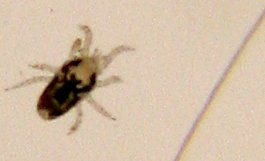
Bites can also occur when people handle birds, poultry, or rodents. For example people who raise poultry and pet store workers frequently report bird mite bites. Adult mites are about 1/32" and often dark in color because of the presence of blood inside the mite (see photo).
Bird mite bites look like mosquito bites
The particular allergic reaction to a bite varies from person to person and even depends on which species of mite caused the bite. In general, however, the bite site will be bright red in color, sometimes surrounded by a rash. The bites often itch and treatment is generally by OTC anti-itch lotions. Obviously you should seek medical attention if the bite becomes infected.
Myths and misinformation about bird mites
There is considerable misinformation about bird mites, much of it propagated by websites promoting remedies to imagined whole-house infestations. There is no evidence whatsoever that any of the bird/rodent/nest mites infest homes. Rather they enter houses when their natural animal hosts abandon their nest or die. They don't establish a permanent infestation in homes because we are not a suitable substitute host.
Bird mites do not jump, hop or fly and in fact can't move very far from their source (notice the short legs in the photo above). So where you find them the original source nest is probably nearby. They don't burrow into skin and are easy to wash off with soap and water. The mites are small but not impossible to see, even without magnification (see photo above). They do not multiply in homes and are not difficult to eliminate once the original animal nest has been removed.
How to eliminate bird mites
The first and most important step is to locate and remove the infested bird or rodent nest. In the case of song birds remember that you should not disturb the occupied nests of most birds in the US because they are protected by endangered species laws. This should not be a problem since mites won't normally leave an occupied nest.
Second, carefully clean the room where mites are found. Vacuum rugs, drapes, furniture and so forth, and dispose of the dust bag outside because mites can escape from the bag. Next, wash hard surfaces with a suitable, mild detergent. Insecticides are generally not needed but if you decide to treat use one of the new botanical, plant-based insecticides (see Using Botanical Pesticides) as a safer alternative to conventional insecticides. If, however, you prefer a more conventional insecticide-based approach to bird mite control see this page at our affiliate DoMyOwn.com.
Supplies
Professional-level pest control supplies are generally not available in home and garden stores but can be found at DoMyOwn.com, our affiliate.

How to search 'Bugs for more information
The easiest way is to open a Google search page and type: "your query" + site:livingwithbugs.com into the search box. For example, to find all 'Bugs articles about carpenter ants type: carpenter ants + site:livingwithbugs.com in the search box.
The resulting list of pages may contain some Google advertising (marked with "Ad" next to the URL) as well relevant pages from 'Bugs. The ads do not originate with 'Bugs.