
Carpenter Ants
-- Big black ants that can cause structural damage --
Summary: Carpenter ants (Camponotus spp.) are large, powerful ants that can destroy wood and other building materials that they nest in. They replace termites as the most important structural insect pest in many temperate (cool) climates such as northeastern and northwestern US.
Carpenter ants that nest in structures can be controlled by creating an insecticide barrier around the building that ants must cross in order to forage for food and water outside. This barrier can be placed inside exterior walls and/or on the exterior foundation (perimeter). It is not necessary to locate the colony or colonies inside the structure itself. Finally, special baits are available that can be deployed when and where ants are active.
Winged and wingless carpenter ants
Carpenter ants are large black, or red and black, ants that nest above ground in cavities such as tree stumps and, sometimes, in the walls, subfloors, or roofs of our houses. Nest building can cause extensive, and expensive, damage to structures.
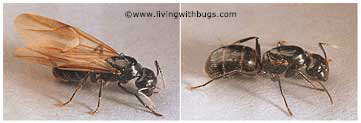
Carpenter ants are generally larger than 3/8" and all black, or red and black. Winged ants, the so-called "reproductives" (below left) may be present in late spring but for most of the year carpenter ants, like other ants, are wingless (below right). All ants have a winged reproductive stage but most are so small you never notice them during the brief reproductive period each year. Carpenter ants, on the other hand, are so large that you'll definitively notice when one of them flies by!
Development of carpenter ant colonies
Like other ants carpenter ant colonies are started by a queen. Large mated queen ants generally fly during late spring ("winged reproductives") and locate a suitable cavity in which to begin a colony by laying eggs. She can use almost any protected cavity such as a wall void, under floor insulation or outside in a natural cavity like a tree stump. The cavity is not always associated with wood since, unlike termites, carpenter ants do not necessarily need wood for survival. As an example, rigid foam insulation is frequently nested in and damaged by these ants.
In the eastern US ant damage is often associated with moisture because colonies tend to start where wood has been moisture-damaged but this is not the case in the western US where colonies and damage can occur in very dry situations.
Once the first brood of female worker ants is produced the queen stays within the nest. The worker ants forage for food and water which they bring back to the nest. Carpenter ants are predators and scavengers and will consume a wide variety of foods however they do not eat wood. This behavior of moving between nest and foraging grounds, combined with their large size, makes them relatively easy to detect during routine inspections. You'll see ants "trailing", moving more or less in a line, between the structure and outdoors.
As the colony grows worker ants excavate and enlarge the original cavity. It is this colony expansion that causes damage to building materials. Colonies can continue to grow over many years and may split into satellite colonies when the original colony gets too large. This means that finding one nest may indicate that there are other satellite nests hidden elsewhere in the structure.
Control of carpenter ant colonies in homes
There is no need for periodic "maintenance treatments", often recommended by pest control companies, nor is it necessary to locate individual carpenter ant nests. Treat only when ant activity is detected during regular inspections. Routine maintenance treatments are a waste of money and may unnecessarily expose residents to insecticide residue.
Inspect exterior of structure at least once each year during warm months, morning or evening. Look for large ants moving into or out of the structure, often in more or less single file lines.
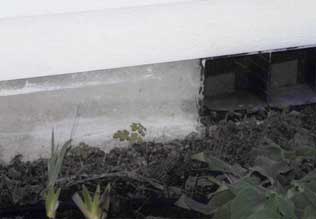
Remove all vegetation in contact with structure, leave at least a 12" gap between plantings and foundation. This ensures that you will be able to see ants that are moving into or away from building. Ants will also use vegetation to "bridge over" the perimeter treatment (see below). Be sure to check for overhanging branches in contact with the structure's roof, and remove as necessary.
The standard treatment to control carpenter ants is generally a two (or three) step process. First, a barrier of insecticide is placed on the building's foundation so that foraging ants must cross it in order to get to their feeding grounds outside. By crossing the barrier worker ants contaminate themselves with insecticide which is then carried back to their nest. Termidor Insecticide can be used for the foundation barrier spray. In addition to the foundation spray, borate powders such as Tim-bor can be placed inside exterior walls (wall voids) so that ants using this interior space will become contaminated.

In the second (or third if wall voids are treated) step, special poison carpenter ant baits can be placed around the foundation where foraging workers will find and carry them back to the nest and destroy the colony. Carpenter ant baits are a new addition to the control arsenal and baits can be used in areas where conventional insecticides can not, or should not, be used. A variety of ant baits can be found here (DoMyOwn.com, our affiliate) but be sure the product is specifically labeled for carpenter ants See this article about these special baits for additional information.
Supplies
Professional-level pest control supplies are generally not available in home and garden stores but can be found at DoMyOwn.com, our affiliate.

How to search 'Bugs for more information
The easiest way is to open a Google search page and type: "your query" + site:livingwithbugs.com into the search box. For example, to find all 'Bugs articles about carpenter ants type: carpenter ants + site:livingwithbugs.com in the search box.
The resulting list of pages may contain some Google advertising (marked with "Ad" next to the URL) as well relevant pages from 'Bugs. The ads do not originate with 'Bugs.