
Powderpost Beetles & Hardwood Floors
-- How do hardwood floors become infested? --
Summary: Hardwood flooring can become infested with lyctid (Lyctidae) powderpost beetle larvae (woodworm) from eggs laid on unfinished wood surfaces usually when the flooring is manufactured or installed. Hatching larvae bore into the wood and can result in extensive damage. Even kiln-dried wood can become infested. Wood flooring can be protected by sealing the surface and/or treating it with borate insecticide during installation.
Hardwood flooring infestations
There are a number of insects that develop in recently dead trees or milled lumber. The larvae of these wood borers feed on starch and other nutrients in the wood that were stored when the tree was alive. Most of these insects cannot infest live trees because of the tree's natural defenses. While most wood boring insects need relatively fresh wood, certain ones, like powderpost beetles, can re-infest older, seasoned wood.
Powderpost beetles (see What are Powderpost Beetles?) lay their eggs on the bare wood surfaces and tiny beetle larvae (sometimes called woodworms) bore into the wood through surface cracks. Extensive internal damage can be done by the larvae during the months or years it takes to complete development (see A Picture of a Lyctid Powderpost Beetle Larva). Adult beetles emerge through small round emergence holes.
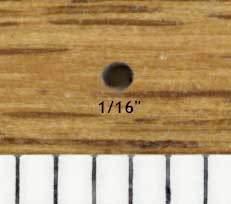
Wood may even be infested after it has been kiln-dried (heat dried) and milled into lumber. Infestation occurs when dried wood is improperly stored near an active infestation . Kiln-drying alone does not protect against infestation, it only eliminates larvae that are present at the time the wood entered the dryer.
Is the powderpost beetle infestation still active?
This is one of the first questions usually asked. Since emergence holes are permanent it is impossible to know for certain if the infestation, buried deep inside the wood, is active if you find just holes in the floor as pictured above. The best indication of an active infestation is the presence of fine, powdery boring dust associated with emergence holes. Another good indicator is the condition of the emergence holes themselves.
Use your hand lens or magnifying glass to look carefully at the emergence holes under a good light. If the walls of the hole are covered with floor finish you can conclude that the holes were made before the finish was applied and may indicate a old, inactive infestation. On the other hand, if the walls appear fresh, not covered with floor finish, you might conclude that beetles emerged recently indicating an active infestation.
Elongated emergence holes indicate that the holes were made before the wood was cut into flooring. Emergence holes are normally round, elongated holes occur when a round log is cut at an angle to the original surface. Another way to distinguish active from inactive infestations is to mark all existing holes with a grease pencil so that new ones can be spotted. You may not ever find beetles, alive or dead, even if the infestation is active.

Control of wood destroying insects
There are two products that can be used to protect new floors from wood destroying insects and fungi. These products are based on insecticidal borates (see What are Borate Insecticides?). Bora Care and Shell-Guard (see this article) are glycol-based borate products while Timbor (see this article) is a pure borate powder without any glycol additive. Timbor is mixed with water to apply. Some studies indicate that glycol helps to carry the borate into the wood, other studies found no difference.
All borate products should be applied before wood is stained and sealed. Bora-Care is a 40% solution whereas Shell-Guard is a 25.3% solution. Keep this difference in mind when comparing costs. Timbor is cheaper than either of the glycol-based borates but does not have the potential benefits of glycol.
Borate solution should be applied to the unfinished back and to the tongue and groove edges with a small brush or paint roller. Apply solution to the top only if it is unfinished. After the solution dries the wood will be impregnated with borate which will prevent beetle larvae from boring into the underside, or edges, once the floor is installed. Don't get the wood too wet as the flooring may warp. And, allow it to dry completely before installation. This procedure won't stop beetles already in the wood floor from emerging but it will prevent new attacks.
For infestations in existing floors you'll need to first determine if the infestation is active (see discussion above). If the infestation is active see Treating Active Beetle Infestations in Wood Flooring.
Supplies
Professional-level pest control supplies are generally not available in home and garden stores but can be found at DoMyOwn.com, our affiliate.

How to search 'Bugs for more information
The easiest way is to open a Google search page and type: "your query" + site:livingwithbugs.com into the search box. For example, to find all 'Bugs articles about carpenter ants type: carpenter ants + site:livingwithbugs.com in the search box.
The resulting list of pages may contain some Google advertising (marked with "Ad" next to the URL) as well relevant pages from 'Bugs. The ads do not originate with 'Bugs.