
Subterranean Termites
-- Termites actually consume wood --
Summary: Termites are the most important wood destroying insects in warm climates. Subterranean termites build nests underground but can enter structures through "shelter tubes" and cause significant damage. Unlike most other wood-damaging insects, termites can actually digest wood fiber directly and use it for food.
Termite identification
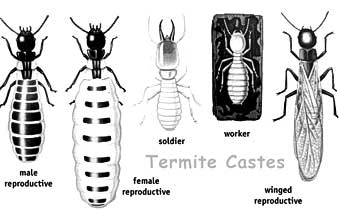
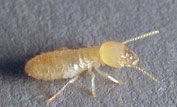
Termites (sometimes mistakenly called "white ants", or "flying ants" while swarming) are small, delicate insects that live in colonies in the soil or in wood. Termites are social insects whose colonies are organized into castes with large "reproductives" and smaller workers and soldiers. Workers feed the colony and tend to the needs of the queen while soldiers defend the colony from invaders such as ants. These highly organized colonies allow termites to be efficient and very destructive when they attack our structures.
Termites eat wood and convert wood fiber, or cellulose, into sugar. A large termite colony can do extensive damage to structures made of wood, or wood fiber such as paper. Since termites often consume wood from the inside out internally damaged wood can appear perfectly normal (see post cross-section drawing).
There are many different types of termites but most occur in warm tropical, semi-tropical, or hot, arid (desert) climates. Subterranean termites live in underground colonies and feed on buried wood. When the initial wood supply is depleted the colony may be extended through "shelter tubes" to above ground wood. This is when damage to structures is done. Shelter tubes are made from soil particles and thus are the color and texture of the local soil. The tubes are built on foundation walls, posts, pilings, in other words anything that spans between soil and wood. Look for termite shelter tubes during annual inspections for insect and water damage and if tubes are found it is an indication that subterranean termites may be active.
Subterranean termite treatment & damage prevention
In the past, starting after World War II, subterranean termites were controlled in new and existing homes by treating the soil around the foundation with highly toxic and persistent insecticides like chlordane and heptachlor. These organochlorine insecticides were used in the US until they were banned in the 1980's. By poisoning the soil with insecticide termites could not build their colonies near homes.
Nowadays termite control treatments combine lower toxicity organophosphate and pyrethroid insecticides, applied to the soil, with termite baits that disrupt colonies (see Termite Control With Baits). Some baits are available for DIY applications (see here for examples). Insecticides that target termites are called termiticides.
See Control of Subterranean Termites for more information.
Home termite inspections
Inspections for subterranean termites can be a little more complicated than inspections for other structural pests like carpenter ants and wood boring beetles. Subterranean termite colonies are generally located in the soil under a structure or inside large structural elements like foundation walls or wooden beams and posts. Since the colonies are hidden you'll need to look for signs of an infestation rather than the termites themselves. One of the best signs of a nearby termite colony is the presence of shelter tubes.
When termites must exit the protection of their colony they construct so called shelter tubes made of soil particles, water, saliva and fecal material (for this reason they are sometimes called mud tubes). Shelter tubes are the termite's highway system that allows them to move from the main colony, which is often underground, to above ground wood. Shelter tube systems may be branched like a tree with the main trunk emerging from the soil (see Shelter Tube Drawing).
Termite baiting systems (see above) can also be used to monitor for subterranean termite activity around a home, especially in warm climates.

During inspections for subterranean termites look for shelter tubes on surfaces that span between the soil and structural wood. Next, with a heavy screwdriver tap on structural beams, posts and other wood that is large enough to support a termite colony. The outside surface of wood with even extensive internal termite damage may appear completely undamaged. Any wood that sounds hollow when tapped should be examined more closely. An ice pick or sharpened screwdriver can be used to test the structural integrity of the wood surface.
Supplies
Professional-level pest control supplies are generally not available in home and garden stores but can be found at DoMyOwn, our affiliate.
How to search 'Bugs for more information
The easiest way is to open a Google search page and type: "your query" + site:livingwithbugs.com into the search box. For example, to find all 'Bugs articles about carpenter ants type: carpenter ants + site:livingwithbugs.com in the search box.
The resulting list of pages may contain some Google advertising (marked with "Ad" next to the URL) as well relevant pages from 'Bugs. The ads do not originate with 'Bugs.