LivingWithBugs Logo

Honey Bees 

- Important pollinators of food crops -

Summary: Honey bees create highly complex, organized societies. Bees collect pollen and plant nectar for food and in the process cross pollinate the plants they visit. Excess plant nectar is transformed into honey for long-term storage.

Jack DeAngelis, PhD
OSU Ext. Entomologist (ret.)

Honey bees are familiar insects to most people. Bees live in complex colonies run by a queen bee that organizes colony behavior by passing chemical signals to worker bees. Worker bees are all females, daughters of the queen. Male bees, drones, are occasionally produced in the colony only when needed to mate with new queen bees.

Honey bee workers collect pollen and plant nectar which is used for food. Bees pollinate the plants they visit in order to collect pollen and plant nectar is transformed into honey for storage and is the colony's main food reserve. Plant pollen serves as the colony's protein food reserve.

Over many centuries we have learned how to domesticate honey bees so they work for us. For example, beekeepers move colonies from place to place where agricultural crops need bee pollination. We also harvest some of the honey that bees produce.

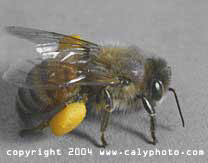
picture of honey bee with pollen sac

Honey bee (Apis mellifera) - Note fine hairs behind head. Yellow sac on hind leg is collected pollen.

Are honey bees dangerous?

No. With one exception, honey bees are much less aggressive than yellowjackets, with which they are often confused.

One strain of honey bees, however, does exhibit extreme aggression when defending their hive. This strain was introduced into South America from bees collected in Africa. The aggressive strain is called Africanized honey bee. Since the introduction of this bee, Africanized honey bees have moved north and are now found throughout the southwestern US (see What are Africanized Bees?).

The study of honey bee biology is a separate branch of entomology. The importance of domesticated honey bees as pollinators has elevated bees to this position. No other single insect is so intensively studied.

Still Have A Question? ... Ask It Here

Related Articles

+ Beekeeping as a Business or Hobby

+ Honey

+ Plant Pollination by Insects

If our information is useful click here to help us maintain and grow 'Bugs!

Don't forget to bookmark us for next time - press ctrl-D in most browsers.

Mission: To provide accurate, up-to-date and unbiased information for solving common insect and mite problems around your home, business and landscape using least-toxic methods.

Jack DeAngelis, Ph.D.

Please see the Disclaimer statements as well.


Copyright © 2004-... LivingWithBugs, LLC. All rights reserved. Page Updated: 1/12/2010