|
|
|
|
Identify Common
Roaches
- It
helps to know what to look for -
|
Summary:
Cockroaches develop from eggs that are protected
inside very distinctive egg cases while
immature cockroach nymphs resemble adults but lack
wings. The adults of the important pest species
differ in both size and color pattern and are fairly
easy to recognize.
Jack
DeAngelis, PhD
OSU Ext.
Entomologist (ret.)
|
|
There are many species of cockroaches
but only a few are commonly found in association
with dwellings and these are the so called the peridomestic***
species. Since your control options (see How
To Control Cockroach Infestations) can vary depending on which cockroach
species is present, correct identification can be
important.
Cockroach identification can
sometimes be made on the basis of egg cases alone.
In some pest species like the German cockroach
the females carry the egg cases around until just
before hatch, but other species like the brownbanded
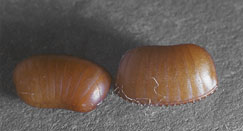
cockroach, drop their egg cases (right) and
can be found during inspections.
***peridomestic = associated
with human dwellings
|
|
|
|
two cockroach egg cases,
(egg capsules or "ootheca") from brownbanded
cockroach; roughly 3/16" long (somewhat
smaller than egg cases of the German
cockroach); each case contains numerous eggs
|
|
|
Cockroach egg cases
Cockroach eggs are normally tucked
safely away inside an egg case, or "ootheca"
(above). Each egg case contains many eggs
lined up in rows. The egg cases are so distinctive in
shape and size that they can often be used to
determine the extent and identity of an infestation.
Eggs hatch in a few weeks and egg cases break open
releasing the young nymphs. Cockroach nymphs look like
a small version of the adults except they lack wing
development (see image of nymph below).
|
|
Common pest cockroaches
German cockroach (Blattella
germanica)
The German cockroach [click for picture] is relatively
small, about 1/2"-5/8" (16 mm) long, brown in
color with two dark stripes behind the head.
This cockroach is found worldwide in association
with human dwellings and is the one most
frequently found infesting homes, apartments,
restaurants, and other places where food is
handled.
Brownbanded
cockroach (Supella longipalpa)
The brownbanded cockroach is relatively
small like the German cockroach (less than
5/8" long) but lacks the stripes behind the head
and is more oval (wider) in shape when viewed from
above.
|
|
 |
|
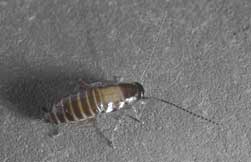
German
cockroach nymph (notice the lack of
wings which identifies this insect as a
nymph).
|
|
American cockroach (Periplaneta
americana)
The American cockroach [click for picture] is considerably
larger than the German or brownbanded
cockroaches at about 1-1/2" (38 mm) long. This
cockroach is light reddish brown, or amber in
color. Both German and American cockroaches can
be found together in the same structure.
Smokybrown cockroach (Periplaneta
fuliginosa)
The smokybrown cockroach [click for picture] is closely
related to the American roach and also relatively large
at about 1-1/2" (38 mm) long. This cockroach is dark
brown in color. The smokybrown cockroach is
especially common in warm and humid climates such as
the southern US.
|
|
|
Cockroach Control
See How to Control
Cockroach Infestations for details. A variety of
baits, traps and insecticides are available here. New baits are highly effective for
control of cockroaches in apartment buildings and
other multi-family dwellings.
|
|
|
Don't forget to bookmark
us for next time - press ctrl-D in most browsers.
|
|
|
|
Mission: To provide accurate, up-to-date and
unbiased information for solving common insect and
mite problems around your home, business and landscape
using least-toxic methods.
Please see the Disclaimer
statements as well.
|
|
|
|
Copyright © 2004-...
LivingWithBugs, LLC. All rights reserved.
|