|
|
|
|
Tent
Fumigation For Structural Pests
-
Expensive, hazardous but sometimes needed
-
|
Summary: Tent
fumigation involves using a poison gas or
hot air to eliminate insect and/or fungal
pests from a structure. Both methods are expensive
and may be hazardous. But, for some pests,
and certain situations, it may be the only method
available.
Jack DeAngelis, PhD
OSU Ext. Entomologist
(ret.)
|
|
Tent fumigation with poison gas or hot air
Fumigation is a method of pest
control in which a pesticide gas, or sometimes
just heated air, is used to eliminate an
infestation of insects or decay fungi. Fumigation
is commonly used in agriculture to control insect
pests and diseases in the soil and grain storage
facilities. Tent, or structure fumigation is used
to treat infestations of certain pests that such
as drywood termites that are not easily
controlled any other way (see What
are Drywood Termites?). In this case the
entire structure is enclosed within a gas-tight
tent made of coated tarp or plastic sheets (see photos).
|
 |
|
Tarp-style tent fumigation
of a small warehouse. Photo by Art
Antonelli
|
|
|
Tenting
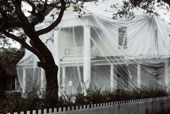
Structures are first enclosed in an
airtight plastic or cloth "tent" (see photos) that
have their edges carefully sealed. Pesticide gas
is then released into the enclosure and allowed to
remain for a specified time, after which the tent
is opened and allowed to vent. In recent years
techniques have been developed that use hot air
instead of pesticide gas as the fumigant. Hot air
fumigation is not available in all areas but is a
safer alternative to poison gas fumigation for
some applications.
|
 |
|
Clear plastic fumigation tent
covering house. Photo by USDA.
|
|
|
Cost of tent fumigation
As you might guess, the cost of tent
fumigation varies by region and size of the
structure but is generally measured in the thousands
of dollars. This does not include costs
associated with living elsewhere while the
treatment is being done. Cost is one reason why we
recommend this type of treatment only in cases
where less drastic measures may not work.
|
|
Disadvantages of fumigation
Fumigation in general suffers from several
drawbacks. It is very expensive and must be
performed by an experienced pest control operator.
It is also inherently hazardous, especially
fumigation that uses poison gas. Structure
fumigation may also require vacating the property
for one to several days. And, since it leaves no
residual protection behind so structures may become
re-infested at anytime after the job is completed.
Despite these drawbacks, fumigation is
sometimes the only practical approach that will
eliminate an existing infestation of certain insect
and fungal pests. The decision whether or not to
fumigate is complex but usually comes down to
balancing the cost of fumigation, often thousands of
dollars, against the cost of additional damage if
you do nothing. See Selecting
Pest Control Services before making the
decision to hire these services.
Ways to Support 'Bugs
If our information is useful please visit the Support Page for ways you can help keep the site growing.
|
|
|
Don't forget to bookmark us for next time - press
ctrl-D in most browsers.
|
|
|
|
Mission: To provide accurate, up-to-date and
unbiased information for solving common insect and
mite problems around your home, business and landscape
using least-toxic methods.
Please see the Disclaimer
statements as well.
|
|
|
|
Copyright © 2004-...
LivingWithBugs, LLC. All rights reserved.
|
