|
|
|
|
Japanese
Beetles
-
A pest of lawns and landscape plants
-
|
Summary: The
larvae, or white grubs, of Japanese
beetle feed on the roots of grasses while
the adult beetles feed on a wide variety of
landscape plants. These beautifully ornate beetles
can be an extremely
destructive turf and landscape pest.
Jack DeAngelis, PhD
OSU Ext. Entomologist
(ret.)
|
|
What are Japanese beetles?
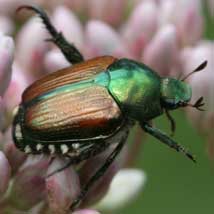
Japanese beetles (right) are important
turf and landscape pests in the eastern US. The
adults are roughly 3/8" long with coppery wing
covers, metallic green back and a row of white
tufts along the sides. Adults feed on a wide
variety of plants where they "skeletonize" leaves
(remove leaf tissue between the veins). Japanese
beetles belong to a large family of ornate beetles
called scarabs (Scarabidae).
Japanese beetle larvae, or white
grubs, are typical of other scarab larvae.
Larvae live in the soil where they feed on plant
roots and can do serious damage. Larvae are white
with a brownish head capsule and three pairs of
legs (see the white
grub article for a picture). The "tail" end
is usually packed with ingested soil particles and
larvae are generally bent into a characteristic
"C" shape as well.
common misspelling: Japanese beatle
|
|
|
Japanese beetle adult ~
3/8" long; photo by David Cappaert,
www.forestryimages.org
|
|
|
Life history of Japanese beetles
Adult beetles emerge from the soil in
mid-summer. Adults feed for a few days then female
beetles begin to lay eggs back in the soil. Larvae
develop in the soil during the fall and spring,
feeding on roots, ready to emerge as adults the
following summer. Root feeding is a major but unseen
part of the damage from these beetles.
Can I control Japanese beetles?
Adult beetles can be hand-picked from
plants and dropped into soapy water. Plant foliage
can be treated with insecticide to prevent feeding
and larvae can be treated with a special microbial
insecticide applied to the soil (see below). Since
Japanese beetle has only one generation per year it
is possible to significantly reduce their population
in a given area with proper treatments.
|
|
Least-toxic insecticides and traps
Botanical
insecticides can be used to treat landscape
plants against Japanese beetle feeding, and neem
oil insecticides are also effective feeding
deterrents but must be re-applied every few days for
as long as beetles are present
Milky Spore controls white grubs like
Japanese beetle larvae
Japanese beetle larvae and other white
grubs can be controlled with a bacterial
insecticide called "Milky Spore". Milky
Spore is applied to the
soil where, over time, the bacteria build up and
infect larvae. Milky spore is very safe and does not
infect other organisms. Milky spore may take several
years to become effective but should be a part of
your arsenal if this pest is an ongoing problem in
your landscape. is applied to the
soil where, over time, the bacteria build up and
infect larvae. Milky spore is very safe and does not
infect other organisms. Milky spore may take several
years to become effective but should be a part of
your arsenal if this pest is an ongoing problem in
your landscape.
Least-toxic
Botanical (Plant-based) Insecticides
Using Neem Oil
Insecticides in the Garden
|
|
|
Don't
forget to bookmark us for next time - press ctrl-D
in most browsers.
|
|
|
|
|
Mission: To provide accurate,
up-to-date and unbiased information for solving
common insect and mite problems around your home,
business and landscape using least-toxic methods.
|
|
|
|
Copyright ©
2004-... LivingWithBugs, LLC. All
rights reserved.
|