|
|
|
|
Cottony
Scale Insects
-
Scale
insects are related to aphids and do similar
damage
-
|
Summary: Scale
insects tap into plants and feed on plant sap,
weakening and even killing plants over time. Cottony
scale insects produce a cottony egg mass
from which the mobile crawler stage hatches. The
young crawler stage is also the easiest stage to
control.
Jack DeAngelis, PhD
OSU Ext. Entomologist
(ret.)
|
|
Scale insects are closely related
to aphids but most don't look like insects at all,
appearing legless and attached to the plant's
leaves or stems (see photo right). Scale insects
feed by tapping into the plant stem or leaf and
withdrawing plant sap. Like aphids, they are often
associated with sticky honeydew which supports the
growth of black, sooty mold.
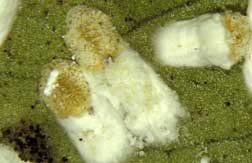
Some scale insects produce a cottony
sac (see photo right) that contains hundreds
or thousands of eggs. Scale insects that make
these cottony egg sacs are called
cottony scales. Eggs generally hatch
in early summer and release the crawler stage,
the only highly mobile stage in the insect's life
cycle. The active crawler stage is also the
one that must be targeted for effective control.
|
|
|
Cottony scale insects
with egg sacs, the white cottony masses.
|
|
|
|
There are many scale insect pests of
ornamental plants and they have very complex life
cycles and host plant interactions. One of the best
comprehensive sources of information about these
pests on ornamental plants is Insects That Feed
on Trees and Shrubs by Johnson and Lyon (google it!).
Plant damage caused by scale insects
Plant damage is related to the sap
that scale insects take from the plant. Over time as
more sap is extracted the plant weakens, leaves may
drop and eventually whole branches may die.
Plants that are stressed by drought,
root damage or disease are better hosts for
many pests including scale insects. These
same stressed plants may be killed by high scale
insect populations. In addition, sooty mold growing
on the leaf surface can interfere with normal
processes and can further weaken the plant.
|
|
Scale insect control
The most important part of scale
insect control is timing. Control measures
must be timed to coincide with hatching of the
crawler stage which usually occurs in early
summer for cottony scales. If properly
timed, and good spray coverage is achieved, soft
insecticides like insecticidal soaps and oils
are just as effective as conventional
insecticides (see Using
Insecticidal Soap For Garden Pest Control).
Over the long run soaps and oils may be more
effective since they preserve the natural enemy
complex which may account for most of the long
term control of these plant pests.
Scout plants starting in late spring.
Use a hand lens to look for scale crawlers
on the underside of leaves or near cottony egg
sacs. Scale crawlers will be about the size of
spider mites but amber in color. Once crawlers
are found control treatments can begin. It may
take several seasons to completely control a
severe scale infestation. Scale infestations
often take years to develop and it is unlikely
that you'll eliminate them overnight.
|
|
|
Don't
forget to bookmark us for next time - press ctrl-D
in most browsers.
|
|
|
|
|
Mission: To provide accurate,
up-to-date and unbiased information for solving
common insect and mite problems around your home,
business and landscape using least-toxic methods.
|
|
|
|
Copyright ©
2004-... LivingWithBugs, LLC. All
rights reserved.
|