|
|
|
|
Silverfish
& Firebrats
- Primitive insects that can damage paper
-
|
Summary: Both
silverfish and firebrats (also called fishmoths
and bristletails) can damage papers, books,
magazines that are in storage, and can infest
stored food products as well. Silverfish
normally occur in damp areas like basements
whereas firebrats seek out drier and
hotter areas like attics.
Jack DeAngelis, PhD
OSU Ext. Entomologist
(ret.)
|
|
This page will help you identify and get
rid of silverfish and firebrats.
These primitive, wingless insects are minor
household pests that can damage stored papers as
well as starchy foods. Both
insects are identified by long antennae
and three long "bristle tails" at the rear
end. In fact, an old common name for them is
"bristletails".
How to identify silverfish &
firebrats
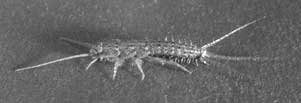
Silverfish and firebrats are 1/2"-3/4"
long when fully grown. Silverfish are somewhat
shiny and silver-grey in color while firebrats are
dull, mottled and grey-brown. Firebrats also have
more stiff "hairs" along the body (see lower photo
at right). Both feed on paper and starchy
materials which may lead them to damage books,
stored papers, pictures, and wallpaper. They will
even get into stored foodstuffs like cereal,
grains and dried meats.
common misspellings and alternate names:
fishmoths, silver fish, fire brats, bristle tails
|
 |
|
|
|
Silverfish (top) and
firebrat (bottom), about 1/2" long.
Note three "tails" at rear end (left in
top image; right in bottom image). The
bottom photo is black & white.
|
|
|
Control of silverfish and firebrats
Silverfish prefer cool, damp
habitats like basements and crawlspaces while firebrats
tend to occur in hotter, drier areas like attics.
For example, our own damp crawlspace, which has a
dirt floor covered with plastic sheeting, produces a
regular of supply of pesky silverfish.
Control of silverfish can usually be
accomplished by reducing water sources.
Insecticide treatment, if absolutely necessary,
should be restricted to non-inhabited areas of the
house such as attics and crawlspaces. Firebrats can
be managed with insecticidal dusts,
including botanical dusts, that are placed in dry
areas where these insects are found (see Related
Articles below). Remember to protect boxes of
valuable books, and other paper documents, by
sealing with tape.
|
|
Safer botanical insecticides
New plant oil, or so called botanical
insecticides are among the few products that
can be safely used indoors for a variety of pests
including silverfish and firebrats. The dust
formulations are especially useful in dry
environments, while the wettable powder (WP) sprays
can be used anywhere. See label instructions for
these applications and as with any insecticide,
please read and carefully follow these
instructions (see Using
Botanical Insecticides)
Safely Using
Insecticidal Dusts
|
|
|
Don't forget to bookmark us for next time - press
ctrl-D in most browsers.
|
|
|
|
Mission: To provide accurate, up-to-date and
unbiased information for solving common insect and
mite problems around your home, business and landscape
using least-toxic methods.
Please see the Disclaimer
statements as well.
|
|
|
|
Copyright © 2004-...
LivingWithBugs, LLC. All rights reserved.
|