|

|
Questions?
Enter keywords in search box below:
|
|
|
Bora-Care
& Shell-Guard
-
Borate-based wood treatments -
|
Summary: Bora-Care and Shell-Guard
are borate-based liquids used to protect both
softwoods and hardwoods against wood destroying
insects and dry rot fungi.
Jack DeAngelis, PhD
OSU Ext. Entomologist (ret.)
|
|
|
Bora-Care (Nisus Corporation) and Shell-Guard
(Perma-Chink Systems) are borate-based wood
treatments for the prevention of decay fungi and
insect damage. Both products use glycol* to increase
the penetration of borate into wood fibers. See the
specimen labels below for technical and
product use information.
As an insecticide/fungicide both Bora-Care
and Shell-Guard are labeled for use against termites,
wood-destroying beetles, carpenter ants,
and wood decay fungi. Both are very
effective against many of the most important wood
destroying organisms and exhibit relatively low
toxicity compared to other pesticides.
common misspellings and common names:
Boracare, Shellguard
*Bora Care contains ethylene glycol
while Shell-Guard contains a less toxic form of glycol
called propylene glycol.
|
 |
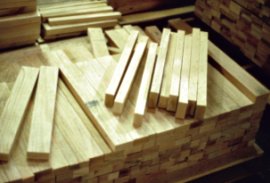
Hardwood
lumber; photo by Stephen Bratkovich,
USDA Forest Service.
|
|
|
|
|
Using
Bora-Care or Shell-Guard
Both
Bora-Care and Shell-Guard are thick liquids
that should be diluted with warm water prior to use.
Most applications call for a 1:1 dilution (see
specimen labels below). Bora-Care is 40% sodium borate
while Shell-Guard is less concentrated at about 25%.
Both can be applied with a garden sprayer, paint brush
or paint roller but follow application instructions
carefully.
The
main advantages of products like Bora-Care and
Shell-Guard, when compared to conventional pesticides,
are: low toxicity, very long residual
activity, highly effective, and low
application costs. The main disadvantage
is that because borates are water soluble they must be
protected from excessive moisture with a water
resistant finish when used in wet environments like
exterior log homes.
|
|
|
Is the glycol really necessary?
Glycol-based borates like Bora-Care and
Shell-Guard are somewhat more expensive than
powdered borates such as TimBor (see Using
TimBor
To
Protect
Wood). However, some studies have shown that
the glycol component helps the borates penetrate
deeper into wood fibers while other studies found no
difference. The active
ingredient in both products is boric acid,
borate is a salt of boric acid. Powdered borates
like TimBor can also be purchased in smaller
quantities so if your job is small this may be the
way to go.
|
|
|
|
|
'Bugs Needs Your Support!
If our information is useful
help us
maintain and grow 'Bugs. Visit our Support
Page or shop at
Amazon, one of our favorite affiliates. Amazon
is not just books and Kindles, they even have bug
stuff!
|
|
|
Don't
forget to bookmark us for next time - press ctrl-D
in most browsers.
|
|
|
|
|
Mission:
To provide accurate, up-to-date and unbiased
information for solving common insect and mite
problems around your home, business and landscape
using least-toxic methods.
Jack
DeAngelis, Ph.D.
Please
see the Disclaimer
statements as well.
|
|
|
|
Copyright
© 2004-... LivingWithBugs, LLC.
All rights reserved.
|