
Dry Rot Damage & Treatment in Wood
-- Wood rot caused by a "wood-eating" fungus --
Summary: Dry rot is a condition of wood in which a fungus (Serpula lacrymans, a type of brown rot fungus) breaks down the wood fibers and renders the wood weak and brittle. Dry rot-damaged wood takes on a distinctive "alligator skin" appearance (the technical term is "cubical fracture"). Even though the wood appears dry and brittle excess moisture is the cause of dry rot because the dry rot fungi require high moisture. Dry rot can be prevented by eliminating excess moisture and treating wood with a preservative such as borate wood preservative.
Dry rot damage is caused by a fungus
Dry rot is the decomposition of wood caused by one of several species of wood decay fungi. The fungus digests the parts of the wood that give the wood strength and stiffness. Weakened wood is typically somewhat dry, hence the name dry rot, and brittle.
Ironically, dry rot usually results from too much moisture in contact with wood because the fungi require wood with a high moisture content. Dry rot damaged wood subsequently dries out and takes on a distinctive blocked appearence (called cubical fracture). If not stopped the dry rot will so weaken the wood that it may eventually fail structurally or even completely disintegrate.
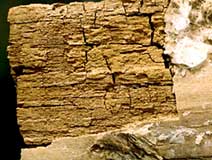
Damage may resemble ant or termite damage
Dry rot can be confused with carpenter ant or termite damage. Carpenter ant damage (see What are Carpenter Ants?) is distinguished by the removal of wood and formation of clean cavities where the carpenter ants live. Subterranean termite damage is similar to dry rot in overall appearance but the presence of live termites, termite galleries and generally wetter wood will usually separate the two conditions (see What are Subterranean Termites?).
Preventing dry rot damage
The best way to prevent dry rot damage is to reduce or eliminate excess moisture. This may be as simple as repairing a leaky pipe or as complicated as stopping water infiltration through a basement foundation. A common cause of dry rot and termite damage is wood in contact with soil as occurs, for example, with a failed foundation.
If moisture cannot be controlled, or if the dry rot fungus has gained a foot-hold, then wood should be treated to inhibit further growth of the fungus. There are many wood preservatives that can be used to treat new or existing wood to protect against wood-destroying organisms including brown rot (dry rot) fungi. The choice of wood preservative is largely dictated by the particular application. Some contain highly toxic chemicals like copper and arsenic or oils that contain chloronated phenols. On the other hand, boric acid, or borate, is an excellent fungicide (a pesticide that kills fungi) prevents insect damage and, is far less toxic than other wood preservatives. Wood can be treated during construction, during repair, or as a remedial treatment to stop an active infestation.
Borate wood preservatives are generally applied as liquids. Because borates are water soluble they should not be used where liquid water is present. In wet situations use fused borate instead because it is made for exterior applications. Fused borate is often used to protect log ends in log homes and utility poles against dry rot.
Treating & preventing dry rot
Treating or preventing dry rot is a three step process. Step 1 is to locate and stop the source of the moisture. Step 2 is to replace any damaged wood that has become structurally weakened. Step 3 is to treat new and existing wood with a borate wood preservative to prevent growth of the dry rot fungus and kill any fungus already in the wood. Borate wood preservative is available as a dry powder or a glycol-based liquid concentrate. The powder form is generally less expensive but there's some evidence that glycol improves the absorption of borate into the wood fibers. One popular liquid borate product that is specifically made to protect wood from dry rot is called Bora-Care (see Using Bora-Care To Protect Wood From Dry Rot) and one of the powder forms is called Tim-Bor (see Using Tim-Bor to Treat Wood Against Dry Rot).
After mixing with water either product can applied to dry, unfinished wood with a garden sprayer or paint roller. Some applications require two coats (see label instructions) and a colored dye such as Turf Mark (tm) is useful to mark treated areas. Neither Tim-Bor nor Bora-Care are generally available in stores but are available here. DoMyOwn.com is one of our affiliates.
Supplies
Professional-level pest control supplies are generally not available in home and garden stores but can be found at DoMyOwn.com, our affiliate.

How to search 'Bugs for more information
The easiest way is to open a Google search page and type: "your query" + site:livingwithbugs.com into the search box. For example, to find all 'Bugs articles about carpenter ants type: carpenter ants + site:livingwithbugs.com in the search box.
The resulting list of pages may contain some Google advertising (marked with "Ad" next to the URL) as well relevant pages from 'Bugs. The ads do not originate with 'Bugs.