|
|
|
|
Codling
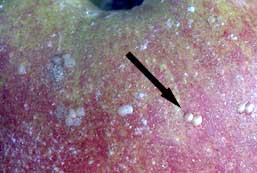
Moth Eggs
-
Tiny
eggs laid on fruit or branches
-
|
Summary: Codling
moths lay eggs on fruit, or nearby branches, of
apples, pears and walnuts. Hatching larvae bore
into the fruit, or nuts, where they develop. Eggs
can be killed with carefully timed, low toxicity
insecticides as long as the sprays are applied
before eggs hatch.
Jack DeAngelis, PhD
OSU Ext. Entomologist
(ret.)
|
|
What do codling moth eggs look like?
Codling moth larvae are the worms of
"wormy apples" but they also infest pears and
walnuts. Larvae hatch from eggs that are
laid on branches, leaves and fruit (see photo
right). Eggs are tiny, flat specks that are very
difficult to see. When first laid the eggs are
clear but become milky white just before hatching
into tiny larvae.
Hatched larvae immediately bore into the
fruit. See What are
Codling Moths? for life history and control
information for these important home orchard
pests.
|
|
|
|
codling moth eggs (arrow)
on an apple
|
|
|
How can wormy apples be used?
Despite their best efforts most home
orchard growers end up with some infested fruit at
the end of the season. There is no need to discard
this fruit. Many people use "wormy", infested apples
to make apple cider or applesauce. Small,
hand-operated apple presses are popular among home
orchardists for making their own cider. Avoid apples that have been on the
ground too long but moderately infested fruit can be
pressed without removing the damaged parts.
Many people also make use of infested fruit
by simply cutting out the infested areas with a
paring knife. If the internal feeding damage is not
too extensive this method is perfectly acceptable.
Fruit can then be eaten fresh, dried or used to make
applesauce.
|
|
|
Don't
forget to bookmark us for next time - press ctrl-D
in most browsers.
|
|
|
|
|
Mission: To provide accurate,
up-to-date and unbiased information for solving
common insect and mite problems around your home,
business and landscape using least-toxic methods.
|
|
|
|
Copyright ©
2004-... LivingWithBugs, LLC. All
rights reserved.
|