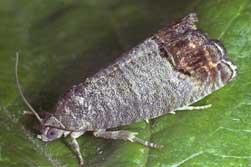
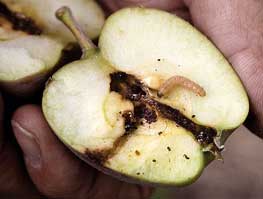
What are codling moths?
Codling moth larvae are the worms
in "wormy apples" (photo, lower right). Codling
moth adults are small grey moths with a
coppery-colored band on the end of the wings
(photo, upper right). Codling moth larvae are
probably the most important insect pests of
apples, pears and walnuts worldwide. Larvae infest
the fruit or nuts and can damage a significant
percentage of a crop if not managed.
There are 2-4
generations of codling moth per year depending on
the length of the growing season. Adult moths
first emerge in late spring. After mating female
moths lay eggs on branches and leaves, later
generations lay eggs on fruit as well (see What
Do Codling Moth Eggs Look Like?).
Hatching larvae immediately bore into the
fruit, or nuts, and begin feeding on the seeds.
Feeding damage can be extensive and may render the
fruit or nuts useless. After completing
development they exit the fruit or nut and seek a
place to pupate either below the tree or under
bark scales. Emerging female moths use a sex
pheromone to attract male moths prior to mating
(see below).
Can codling moth damage be prevented
without insecticides?
Commercial fruit and nut growers use
insecticides, traps, and mating disruption
pheromones to protect orchards against
codling moths. Homeowners can use many of these
same techniques but on a smaller scale.