|
|
|
|
Flea & Tick
Control
-
Control of these blood-sucking arthropods -
|
Summary:
To save time and effort most people will
eventually opt for one of the new pet medications
(insecticides) that controls both fleas and ticks in
one easy step. Use this article to make an informed
decision about which flea and tick control method to
use.
Jack
DeAngelis, PhD
OSU Ext.
Entomologist (ret.)
|
|
Flea control in homes
The most important thing to keep in
mind is that both adult fleas and flea larvae
must be controlled at the same time. Since larvae
are found in the pet's bedding and adults spend
most of their time on your pet, both places should
be treated. Pets can be treated with flea and tick
shampoo and combing but new topical medications
make flea control much easier and nearly 100%
effective (see details below).
Any indoor space can be treated with
the insect growth regulator called methoprene
to prevent larval fleas from developing into
adults thus breaking the life cycle and
effectively ending the infestation in the home.
See Related Articles below for details
about using methoprene.
|
|
|
|
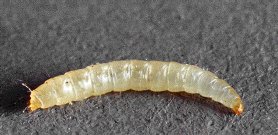
flea larva. This stage
lives in the animal's "nest" or bedding.
Larvae do not bite but live on debris in the
nest.
|
|
|
Tick control
Like fleas, ticks (right) feed on the
blood of their host animals such as mammals, birds
and reptiles. Ticks hop onto their host animal to
feed for a period (1 to several days) then drop off
to digest the meal. All stages require a blood meal
in order to grow.
The only way to effectively prevent
tick bites is to treat the animal with an
insecticide. These insecticides can be delivered
either by a slow-release flea and tick collar
(see Do Flea & Tick
Collars Work?) or an insecticide applied
directly to the animal's skin. Some "topical
medications" that are effective against fleas are
also effective against ticks.
Ticks do not infest homes but can be
carried indoors on pets and may sometimes be
transferred from pets to people by close contact. It
is therefore not necessary to treat indoors for
ticks.
|
 |
|
tick (unfed). After
feeding on blood from an animal host the body
of this tick will swell to several times its
original size.
|
|
|
Simple flea & tick control
Most people will eventually opt for
some type of insecticide-based flea and tick control
because older methods require so much time and
effort. Insecticidal medications are somewhat more
expensive but they do save time, and, for many
people, time equals money. Also, insecticides such
as flea collars or topical medications are the only
realistic option to prevent tick bites.
There are two different types of flea
control medications. One type is applied as drops of
liquid to the pet's skin. These are called "topical"
or "spot-on" medications and some control
ticks as well. The second type is given orally and
are sometimes called "systemic"
because once taken the medications are absorbed and
circulate in the animal's blood. These oral
medications typically do not control ticks.
|
|
Spot-on flea medications
Frontline
Top Spot (tm) is my first choice for an
all-purpose, topical flea and tick
control medication for both dogs and cats, and Frontline Plus (tm) adds
methoprene to the basic ingredient in Frontline Top
Spot. I prefer to apply methoprene as a separate
application (see Using
Insect Growth Regulators for Flea Control). Advantage
(tm) is my second choice for an all-purpose
topical flea control medication but Advantage does not
control ticks.
A number of lower-cost, spot-on
products as well as K9 Advantix (tm) contain the
active ingredient permethrin or some other
pyrethroid type insecticide. I do not recommend
using these products because of the dangers they
pose to cats that might come in contact with these
insecticides.
Caution: Do not use
flea & tick medications that contain permethrin,
or any pyrethroid insecticide, on cats or
even in households that have cats. Certain pyrethroid insecticides like
permethrin are toxic to cats and should not be used
around them. Check the label and avoid products
whose active ingredient ends in "-thrin" such
as permethrin or cyphenothrin if you
have cats living in the house.
|
|
Other flea medications
Program
(tm) is an oral
medication that acts as an insect growth
regulator, preventing larval fleas from maturing
into adult fleas. It is administered once a month.
Program (tm) does not control adult fleas or
ticks directly. Capstar (tm) is also
an oral medication that acts quickly to control
adult fleas (not ticks) on dogs and cats. It is
safe for young animals (see label) so might be
used to quickly control a flea infestation in very
young animals that cannot be treated by
other means.
Whichever medication you decide to use
don't forget to also treat your pet's sleeping
areas with methoprene for long-term flea
control (see Using
Methoprene To Stop Flea Development).
Precautions with any new
medication
Like any medication there is a small
percentage of animals that will react badly to any
of the flea and tick treatments. The risk is small
compared to the benefits but these medications
are, after all, essentially insecticides. To
minimize the risks of an adverse reaction you
should: (1) Always apply the topical,
spot-on, medications in a way that prevents
the animal from licking on the spot where
the medications are applied; usually this is the
pet's back, at base of neck. You may need to watch
the animal for a few hours to make sure they are
not licking the application site. (2)
Carefully follow package instructions as
to dosage and timing. If your pet is only a few
pounds over the weight limit for a particular dose
you may want to use the lower weight range
dose. (3) Split the dose the
first time you use it. When using a new
medication on our dogs we always apply just half
the recommended dose then wait 24 hours and apply
the second half-dose if all goes well. If an
adverse reaction does happen it is better to have
only a half dose in the animal's system.
How Fleas Develop in
Our Homes
Flea
Control Without Expensive Pet Meds
What are Ticks?
|
|
|
Don't forget to bookmark
us for next time - press ctrl-D in most browsers.
|
|
|
|
Mission: To provide accurate, up-to-date and
unbiased information for solving common insect and
mite problems around your home, business and landscape
using least-toxic methods.
Please see the Disclaimer
statements as well.
|
|
|
|
Copyright © 2004-...
LivingWithBugs, LLC. All rights reserved.
|