Our House


Fungus Gnat (Sciaridae)

- Small, dark flies that develop in soil -

Summary: Fungus gnats are small, dark flies that can be important pests in greenhouses, interior plantscapes and potted houseplants. They are also pests of commercial mushroom production. Larvae damage plant roots.

Jack DeAngelis, PhD
OSU Ext. Entomologist (ret.)

What are fungus gnats?

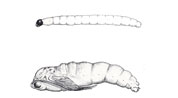
Fungus gnats (right) are small (~1/8"), dark, primitive* flies that often plague potted houseplants, interior plantscapes, greenhouses, and commercial mushroom growers (sciarid flies). Fungus gnat larvae live in soil where they feed on soil fungi and plant roots. Full grown fungus gnat larvae are about 1/4" long and have a very distinct, dark head capsule (lower right).

Fungus gnat larvae damage plant roots

Adult flies can be a nuisance when present in high numbers but the damaging stage is the larvae that feed on plant roots. Fungus gnat larvae can do significant damage to young plants that don't yet have a developed root system. They are most often a problem in greenhouses and potted houseplants.

Fungus gnats may have many generations per year so populations can build quickly under favorable, warm conditions. The best, and safest, way to mange fungus gnat damage is to monitor for adult flies using yellow-colored sticky traps. If an infestation is found you can treat soil with a low-toxicity microbial insecticide (see below for details).

* Primitive flies are the gnats, midges and mosquitoes. These are generally small (except crane flies), delicate flies with long antennae. The "higher" flies, like house flies, have short antennae and tend to be larger and more robust.

fungus gnat
fungus gnat larva and pupa
Fungus gnat drawings (magnified). Adult fly (upper); larva (middle) and pupa (lower).
 

Get rid of fungus gnats with traps and microbial insecticides

Fungus gnats can often be managed by simply lowering soil moisture. You should always allow the top inch (2.5cm) of soil in pots to dry out before watering. This will prevent root rot and help to manage many soil insect pests, including fungus gnats. If limiting soil moisture is not an option then use a combination of yellow sticky traps and microbial insecticide to control larvae that live in the soil.

Using yellow sticky traps

Yellow sticky card traps can be used to monitor for fungus gnats, aphids, thrips and whiteflies. Adult flies are attracted to the yellow color and become stuck on the glued surface.

When used alone, however, sticky traps probably won't "trap out" an infestation so traps should be combined with some type of soil treatment to control larvae. Plan to treat the soil when more than a few flies are trapped every day. Use 1-2 traps per 1000 square feet of greenhouse space or indoor plantscape. Replace traps when they become covered with fungus gnats or debris.

Using microbial insecticides

Certain types of the microbial insecticide Bacillus thurengienesis israelensis (Bti) are effective against fungus gnat larvae when applied as a drench to the soil. These microbes are completely safe for plants and animals, including us. Gnatrol is a brand of Bti that is available in quart packaging. Plan to treat three times, with treatments about 1 week apart. Follow package instructions carefully in terms of when and how much Bti to apply. Be sure whatever product you use contains Bti and not the other strains of Bt which are meant for other types of pests.

The Pest Management Store

Identification guides, reference and gardening books, etc.

Google

Mission: To provide accurate, up-to-date and unbiased information for solving common insect and mite problems around your home, business and landscape using least-toxic methods.

Jack DeAngelis, Ph.D.

Please see the Disclaimer statements as well.


Copyright 2004-2008 LivingWithBugs, LLC. All Rights Reserved.