Our House


Black Vine Weevil & Other Root Weevils

- Larvae damage roots sometimes killing plants -

Summary: Root weevils can be severe pests of many landscape plants. Larvae damage roots while adults feed on leaves. Control efforts should be directed at the leaf-feeding stage in early summer.

Jack DeAngelis, PhD
OSU Ext. Entomologist (ret.)

What are root weevils?

Black vine weevils (Otiorhynchus sulcatus) are one of numerous species of weevils (snout beetles) whose larvae feed on plant roots. Because larvae damage roots they are sometimes collectively called root weevils. Root damage can be so severe that plants, especially young or shallow-rooted ones, can be killed. Older larvae can also girdle (remove bark) stems as well. In fact, root weevils are among the most damaging of woody landscape plant pests worldwide.

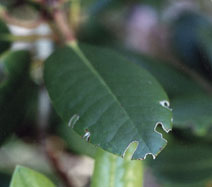
Adult weevils feed on plant leaves resulting in characteristic notching (right). There is generally only one generation per year and control efforts should be directed at newly emerged adults, not larvae. When notching of new growth is first found in early summer you should begin your control program.

Common names and misspellings: strawberry weevil, obscure weevil, rootweevil, and blackvine weevil.

leaf notching by black vine weevil

Rhododendron leaf with notches caused by black vine weevil adult. Photo by JD DeAngelis, 2005, calyphoto.com.


Least-toxic root weevil control

The critical time for root weevil control is when the adult beetles start to emerge from the soil. Weevils feed for about 4 weeks after emerging from their underground pupal chambers. After feeding they begin to lay eggs for the next generation. The best time for control is between when feeding notches first appear on new leaves and the start of egg laying, 4-6 weeks later. For the black vine weevil this period is early summer.

For gardeners interested in a low toxicity approach to black vine weevil control you can disrupt feeding and egg laying in early summer with neem oil insecticides applied to leaves. Then, if necessary, control larvae with fall applications of insect-parasitic nematodes.

Use parasitic nematodes to control weevil larvae

Using insect parasitic nematodes to control larvae is a bit more difficult than treating adult weevils with insecticides. First is the problem of timing. You must apply nematodes when the soil is moist and not too cold. Second, nematodes must be applied exactly according to package instructions because they are fragile and easily destroyed. If, however, you fail to control adult weevils during the summer then fall treatments using nematodes may be your best bet. Nematodes are non-toxic to plants and other animals.

Printable guide to root weevils: Root Weevil Guide (pdf); See this guide for pictures of black vine weevil adults and larvae.You'll need Acrobat Reader or equivalent to open this pdf file.

The Pest Management Store

Identification guides, reference and gardening books, etc.

Google

Mission: To provide accurate, up-to-date and unbiased information for solving common insect and mite problems around your home, business and landscape using least-toxic methods.

Jack DeAngelis, Ph.D.

Please see the Disclaimer statements as well (sorry, but these are necessary).


Copyright 2004-2007 livingwithbugs.com. All Rights Reserved. Page Updated: 11/22/2007