|
|
|
|
Spider Mites
-
Spider mites are the most important plant pest overall
-
|
Summary:
Spider mites are tiny plant-feeding mites that cause
significant damage to gardens and houseplants,
as well as agricultural crops world-wide.
Gardeners can reduce damage from spider mites using
low-toxicity insecticidal soap.
Jack
DeAngelis, PhD
OSU Ext.
Entomologist (ret.)
|
|
Spider mite identification
Spider mites are small,
plant-feeding mites that may severely damage
plants. Mites pierce the leaf surface, disrupt leaf
tissue and extract cell contents. Mite feeding makes
a hole in the leaf's protective layer and leaves
eventually dry out and turn brown because of water
loss through these tiny holes.
Spider mites have eight legs in all
stages except larvae which have only six and they
develop from egg to adult in as little as two
weeks during summer. There can be many generations
each year and most spider mites spend winter
months as adult females hiding in plant debris at
ground level or under bark scales on perennial
plants.
Spider mites have many natural
enemies but other mites, called predator
mites, are the most important. Lady
beetles, syrphid flies and lacewings also are good
predators of spider mites. Spider mite control in
gardens and houseplants is relatively simple using
the same methods that are used for aphids.
Common misspellings and misnomers
for spider mites: red mites, red spiders,
spidermites.
|
 |
|
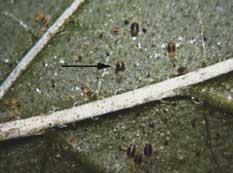
Spider mites on bean
leaf. Large, dark mites (black arrow) are
adult females. This is the view through a
good hand lens or magnifying glass.
|
|
|
|
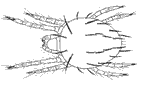
Line drawing of a spider
mite ("head" toward left). Note
"hairs" (setae) on legs and back.
|
|
|
Least-toxic spider mite and aphid control
Scout for pests often during the
growing season. Hold a piece of white paper under
the leaves where you suspect an infestation. Tap on
the branch hard enough to dislodge any mites, but
not too hard! If spider mites are present they will
appear as tiny, dark flecks, that are moving,
on the white paper -- they are about the size of
table salt. Any lighter, and faster mites that you
see may be predators. Use your hand lens to get a
closer look.
If spider mites are found pick a
sunny, warm (about 75-85°F) day to apply control
measures. In the morning hose off the plants to
remove as many mites and eggs as possible. This
washing will remove dust, dirt and other debris that
favor mites as well. Use enough water pressure to
dislodge mites, but be careful not to damage the
plant.
|
|
Next, mix up a solution of insecticidal
soap (see Using
Insecticidal Soap For Spider Mites). Apply
spray to all leaf surfaces where mites may be
hiding. Do the application in the morning because
soap can burn foliage when air temperature is high.
Before the soap solution dries rinse it off with a
second spray of water. This final step will remove
residual soap that might burn tender leaf tissue.
Repeat these steps at 1-2 weeks until you no longer
find mites. This procedure will work for houseplants
as well.
One final caution: soap solution
should be almost clear with a slight milky color
when mixed. Don't use the solution if it is milky
white or solids form in the container as this is an
indication that the soap has "gone bad" and may
damage your plants.
|
|
Spruce spider mite
For landscape plants called conifers
such as arbovitae, spruce, pine, and fir the
procedure is a little different. Spruce spider
mite (Oligonychus ununguis) is the most
common spider mite on conifers. Unlike other spider
mites, spruce spider mites lay eggs in the fall
that won't hatch until the following spring. Other
spider mites stop laying eggs by late summer but
clusters of the spruce spider mite's red "winter
egg" can be found on stems and needles during winter
months.
Winter eggs can be effectively
controlled by late winter applications of
horticultural or dormant oils. During summer, spruce
spider mites can usually be controlled with washing
and insecticidal soap as outlined above for other
spider mites (see How to Reduce
Damage From Spruce Spider Mites).
How
Do Spider Mites Damage Plants?
What are
"Beneficials" or Natural Enemies?
Using a Hand Lens
for Garden Pest Identification
Ways to Support 'Bugs
If our information is useful please visit the Support Page for ways you can help keep the site growing.
|
|
|
Don't forget to bookmark
us for next time - press ctrl-D in most browsers.
|
|
|
|
Copyright © 2004-...
LivingWithBugs, LLC. All rights reserved.
|