|
|
Spider Identification
- Know which species are poisonous in YOUR area -
|
Summary: Spider identification can be tricky. Fortunately very few species pose any real threat in terms of a poisonous bite. Learn which, if any, poisonous species occur where you live and learn how to avoid them.
Jack DeAngelis, PhD
OSU Ext. Entomologist (ret.)
|
|
|
|
Spider identification can be very tricky especially once you get below the level of the family classification. Species and genus-level determinations generally require a good stereomicroscope plus some experience. You can, however, usually figure out higher level classification by comparing your specimen to a drawing or photograph.
What's important for most people is to be able to identify the poisonous species, if any, where you live. Since by far the majority of spiders are harmless this should be a very short list.
For example, in North America, north of Mexico, there are only a few species of spiders that pose any real threat to people. Once you learn to recognize and avoid the few poisonous species you can relax. For all other spiders you should use a field guide with good color pictures and range maps to do your identification (see below).
|
|
|
|
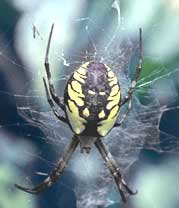
a harmless common garden spider
|
|
|
|
Poisonous spiders in the US
Most spiders are harmless or even beneficial. A few, however, are capable of delivering a poisonous bite. Learn about, and be able to identify, the major poisonous species in North America so that you can avoid them.
Control indoor spiders with sticky traps
The most dangerous indoor spider species can be effectively trapped with homemade spider traps. This article explains how to construct sticky board traps for household spiders. Low toxicity, natural plant oil insecticides are now available for use indoors as well.
|
|
|
|
|
Biology & identification of spiders
Field guides (left), with good illustratons, are essential for proper spider identifcation. The Audubon Society Insect & Spiders Field Guide is an excellent general guide while How to Know The Spiders is more in depth and specific. Students, especially, will be interested in the Biology of Spiders.
Spider photos
An excellent collection of photos you can use to compare your spider with identified specimens.
|
|
|
|
New botanical insectcides like EcoExempt D (right) can be safely used indoors for a variety of pests, including spiders. See label instructions for these applications.
As with any insecticide, please read and carefully follow these instructions.
|
|
|
|
|
|
|
|