|

|
Questions?
Enter keywords in search box below:
|
|
|
|
Spider Identification
- Know which species are
venomous -
|
Summary:
Spider identification can be tricky and except for a
few common species can not be done based on color
patterns alone. Fortunately very few species pose
any real threat in terms of a venomous or poisonous
bite. Learn which, if any, venomous species occur
where you live then learn how to avoid them.
Jack
DeAngelis, PhD
OSU Ext.
Entomologist (ret.)
|
|
|
|
|
The
spiders are an extremely large and diverse group
with thousands of species. While most spiders are
harmless a few are dangerously venomous. Spider
identification can be very tricky once you get
below the level of family classification. Species
and genus-level determinations generally require a
good stereo-microscope plus some experience. You
may, however, be able to figure out higher level
classification by comparing your specimen to a
drawing or photograph.
What's
important for most people is to be able to
accurately identify the poisonous or venomous
species that occur around where they live. In
the US three species are commonly blamed for
venomous bites: the hobo spider, the brown
recluse spider and the black widow spider
(see links above and Common
Venomous Spiders In The US).
Once you
learn to recognize and avoid the few venomous
species where you live you
can relax. For all other spiders you should
use a field guide with good color pictures and range
maps to do your identification (see below and Field
Guides).
|
|
|
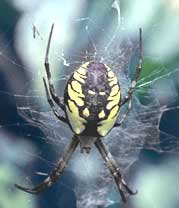
Color
patterns alone are not reliable enough for
accurate spider identification. This
scary-looking spider is actually harmless.
|
|
|
|
|
Spider identification guide
Most experts agree that you'll need a
microscope or hand lens and good reference materials
to identify even common spiders. You should not rely
on color patterns alone because these can be
very confusing and not consistent from specimen to
specimen.
A
better approach is to identify particular
characters in each species that distinguish it
from other, similar species and a guidebook is the
only way to do this accurately. There are many
books for spider experts that have access to good
microscopes and a lot of experience but How to Know the Spiders
(Pictured Key Nature Series)
is an in-depth and specific guide to spider
identification that will be useful for non-experts
as well. For less detail, and a less expensive
approach, try one of these field
guides.
|
|
|
Control
indoor spiders with sticky traps
The most
dangerous indoor spider species can be effectively
trapped with homemade or commercial spider traps.
See our recommended supplies here
and How To Use Sticky
Traps For Indoor Spiders for
information about constructing sticky board traps
for household spiders.
|
|
|
If our
information is useful click
here to
help us maintain and grow 'Bugs! You can also support
'Bugs
by shopping through this Amazon link
or the Amazon.com banner (left).
|
|
|
Don't forget to bookmark
us for next time - press ctrl-D in most browsers.
|
|
|
|
Mission: To provide accurate, up-to-date and
unbiased information for solving common insect and
mite problems around your home, business and landscape
using least-toxic methods.
Jack DeAngelis, PhD,
, email:
[email protected]
Please see the Disclaimer
statements as well.
|
|
|
|
Copyright © 2004-...
LivingWithBugs, LLC. All rights reserved.
|