|
|
|
|
European
Paper Wasp
- A classic
invasive insect species in the US -
|
Summary: The European
paper wasp, Polistes dominula, is a
relatively new paper wasp species in North America
and has enjoyed a rapid increase in geographical
spread in recent years. In some areas it is
displacing native paper wasps and becoming a
significant nuisance pest.
Jack DeAngelis, PhD
OSU Ext. Entomologist
(ret.)
|
|
Paper wasps
Paper wasps are closely related to
yellowjacket
wasps. You can tell them apart because paper
wasps generally have significantly longer hind
legs which hang below the abdomen in flight.
Paper wasps also make smaller nests with an open,
cells exposed (see photo below, right),
architecture.
Paper wasps normally go about their
business pretty much unnoticed. Most native (US)
species make relatively small nests and locate
them in out-of-the-way places. They are not
aggressive so there is little threat of swarming.
Paper wasps are excellent predators and
unlike some scavenger yellowjackets are not
interested in our picnic food.
The European paper wasp is not a typical
paper wasp
The European paper wasp is not
native to North America. It arrived in the New
World sometime before 1981 appearing first in
Massachusetts and has since spread westward now
occurring as far west as California, Oregon and
Washington. Its native range is Europe to China
and is the most common paper wasp in Western
Europe.
This new wasp makes a larger nest
than our native paper wasp species and places
these nests in more accessible places. Whereas
native paper wasps build nests in high,
out-of-the-way sites such as along the eves of a
roof, European paper wasps also build nests closer
to the ground in areas where we might accidentally
make contact. Numerous, hidden nests can increase
the likelihood of unpleasant encounters between
wasps and gardeners (see below). Finally, this
wasp is such a successful colonizer that
it sometimes displaces native paper wasp species.
Because it is not native, the European
paper wasp has experienced so-called "ecological
release" typical of other invasive species
that arrive without their own native predators and
parasites. This has resulted in a rapid
geographical spread and large populations where
this wasp occurs.
|
|
|
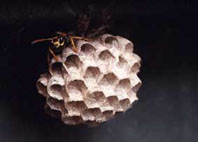
European paper wasp queen
(about the size of a US Lincoln penny).
Note yellowjacket-like coloration. Photo
by JD DeAngelis.
|
|
|
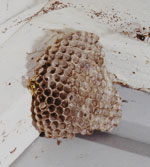
Open nest structure with
exposed cells that is typical of paper
wasps. Photo by JD DeAngelis.
|
|
|
Identification &
mis-identification
Most people, even some entomologists,
still mistakenly identify the European paper
wasp as a yellowjacket (Vespula spp.). If
you compare the two the European paper wasp is a
little larger than a typical yellowjacket, but
smaller than our native paper wasps, and has a
very similar yellow over black color pattern.
The easiest way to tell them apart is like all
paper wasps the European paper wasp has long
hind legs that seem to "dangle" below the body
in flight. European paper wasp workers are also
not as aggressive as yellowjacket workers
but more aggressive than other paper wasps.
|
|
|
Life history of paper wasps
The life cycle of European paper wasp is
typical of other paper wasps and yellowjackets.
Queens emerge from overwintering sites in spring to
start a new nest. Once underway, queens remain at
the nest to lay eggs while workers, sterile females,
provision and build the nest.
European paper wasps start nest
building a little earlier in spring than our
native species which may account, in part, for its
relative success. Nests grow throughout the summer,
a batch of males, called drones, is produced in the
fall. Drones mate with newly produced queens. These
new queens are the only members of the colony that
survive the winter. Nests normally are not reused
the following spring.
|
|
|
|
|
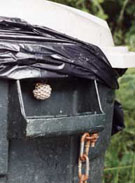
European paper wasp nest
built under a flap of a trashcan liner
(left-hand image). Close-up of nest
(right-hand image); notice wasp, possibly
the queen. Photos by Elizabeth DeAngelis.
|
|
Close encounters with paper wasp nests
These photos illustrate why you are more
likely to have an unpleasant, painful encounter
with the European paper wasp than other paper wasp
species. The relatively large nest has been built in
an area where unsuspecting hands might go (far
left). Other paper wasp species tend to build
smaller nests in more out-of-the-way places, less
likely to be touched by accident.
While this wasp certainly will sting it is
unlikely to swarm thus reducing the overall
threat compared to the more aggressive
yellowjackets.
|
|
|
Control of paper wasps
Paper wasps are not attracted to artificial
wasp traps nor will poison baits likely work because
paper wasps require live prey. The only control now
is to destroy individual nests as you encounter them
with a Wasp & Hornet-type insecticide (see How
to Control a Wasp Nest). Be aware, however,
that this wasp is a excellent predator of
many pest insects so should be left alone if
at all possible.
So, while they may be annoying at times
they are probably doing your garden and landscape a
lot of good! In some areas, however, this wasp may
be having a negative impact on rare or endangered
butterflies. Eventually, this invasive species
will be "found" by some predator and/or parasite
and will then begin to decline in numbers.
|
|
|
Update: This year
(2015) I think I am starting to see significant
nest disturbance in our local (western
Oregon) European paper wasps. On several occasions
I've found remnants of nests on the ground that appear
to have been torn from their moorings. Also, the
number of nests that I have encountered this year is
way down compared to previous years. If nests are
being destroyed by a predator my guess is that birds
are doing it but I have no direct evidence so far.
|
|
|
Don't forget to bookmark us for next time - press
ctrl-D in most browsers.
|
|
|
|
Mission: To provide accurate, up-to-date and
unbiased information for solving common insect and
mite problems around your home, business and landscape
using least-toxic methods.
Please see the Disclaimer
statements as well.
|
|
|
|
Copyright © 2004-...
LivingWithBugs, LLC. All rights reserved.
|