Questions? Enter keywords in search box below:


Using Termite Baits 

- Baits fool worker termites into poisoning the colony -

Summary: Termite baits are a low toxicity alternative to soil-applied termiticides/insecticides to protect homes from termite damage. Baits can also be used in conjunction with conventional insecticide treatments.

Jack DeAngelis, PhD
OSU Ext. Entomologist (ret.)

Termite baits

Special termite baits are now available to monitor and eliminate subterranean termite colonies. Baits consist of some type of cellulose, which is the part of wood that termites need, that may, or may not, be laced with insecticide or insect growth regulator. The different baiting systems (see below) differ in how they present the bait to foraging termites and which insecticide or growth regulator is used. The advantage of baits over soil treatments is that baiting uses far less insecticide and is more eco-friendly than conventional treatments.

Termite baiting works by essentially fooling worker termites into taking poisoned bait back to the colony. Foraging worker termites find the bait and recruit fellow workers to the new "food source". The colony, and queen, are slowly poisoned when the toxin is brought back and fed to the nest.

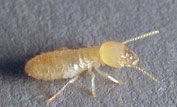
termite baits attract worker termites

A subterranean termite worker, or "sub". Workers locate bait and bring it back to the nest where it is fed to nestmates.


Is termite baiting a DIY project?

Baiting for termite control can be complicated and time-consuming. Most homeowners will conclude that the time and effort involved is more than they want to commit. In this case an experienced pest control company should be hired to set-up your baiting program. On the other hand, DIY termite baiting can be very economical compared to professional, post-construction treatments (see Termite Control Options).

There are a number of termite baiting systems that all work pretty much the same. First, stations are placed either above ground or buried below ground. These initial stations usually do not contain poison, their only purpose is to establish a foraging pattern. Once termite feeding is established the poison is placed in the stations. Poisoned cellulose bait is then carried back to the colonies by the worker termites.


Popular termite bait systems (manufacturer)

Advance (Whitmire Micro Gen) - available as DIY; uses diflubenzuron insect growth regulator

Firstline (FMC) - available as DIY; uses sulfluramid a slow-acting insecticide

Sentricon (Dow) - generally not available as DIY

Subterfuge (BASF) - generally not available as DIY

Do I need to bait for termites?

Baiting is best used in areas where subterranean termites are the dominant structural insect pest such as regions with a warm tropical or semi-tropical climate. For example, baiting should be a part of your regular termite management if you live in Florida, Georgia, Alabama, Mississippi, North & South Carolina, Louisiana, Texas, Hawaii, and northern Australia. Baiting may not be of much benefit if you live in an area where subterranean termites are not the dominant structural pest.

Baiting can be a do it yourself (DIY) project as kits and individual components are now available for some bait systems (left). Some kits can be purchased online; see Termite Bait Systems & Supplies. However, it takes time and effort to establish the baiting stations and monitor them effectively. Instructions for establishing and monitoring the stations differ somewhat between products but are explained in detail on the package labels. It is important that you follow these instructions carefully.

Still Have A Question? ... Ask It Here

Related Articles

+ Termite Life History

+ How to Select Pest Control Services


If our information is useful click here to help us maintain and grow 'Bugs!

Don't forget to bookmark us for next time - press ctrl-D in most browsers.

Mission: To provide accurate, up-to-date and unbiased information for solving common insect and mite problems around your home, business and landscape using least-toxic methods.

Jack DeAngelis, Ph.D.

Please see the Disclaimer statements as well.


Copyright © 2004-... LivingWithBugs, LLC. All rights reserved.