Our House
advice


Questions About Carpenter Ants

Summary: In my nearly 20 years of fielding questions about carpenter ants these are the ones most often asked by homeowners and Master Gardeners.

Jack DeAngelis, PhD
OSU Ext. Entomologist (ret.)

The following questions come mainly from homeowners concerned about seeing these large ants around their homes.

Please refer to our carpenter ant identification and carpenter ant control articles for additional information.

winged & wingless carpenter ants
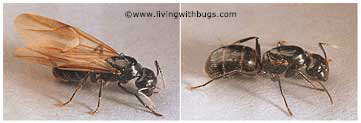
Winged (left) and wingless (right) carpenter ants

Q: Should I worry about finding a few carpenter ants inside our house?

A: Usually not. At certain times of the year carpenter ant nests located outside, but near houses, release large numbers of winged ants that are capable of flying in through open doors and windows. The presence of these ants indoors is no reason for concern. If more than a few ants are found together, however, there may be a problem with a nest in the walls.

Q: Should I worry about finding a few carpenter ants outdoors?

A: No. In many areas carpenter ants (Camponotus spp.) are very common. It is therefore not unusual to encounter these large ants outdoors. They are everywhere. The key point here is if they seem to be moving in a directed way toward or away from the house. This "trailing" behavior may indicate a nest located inside. Otherwise, finding ants outside should be no concern.

Q: Are "wall void" treatments for carpenter ants safe?

A: Yes. The standard treatment for carpenter ants involves placing a band of insecticide in the exterior wall voids completely around the house. This insecticide is placed out of reach and has no dangerous fumes if done properly.

Q: Are periodic maintenance treatments for carpenter ants necessary?

A: No. Regular perimeter treatments are not needed to control carpenter ants. Once interior nests are eliminated by a properly done initial treatment the only needed follow-up is routine inspections.


Mission: To provide accurate, up-to-date and unbiased information for solving common insect and mite problems around your home, business and landscape using least-toxic methods.

Jack DeAngelis, Ph.D.

Please see the Disclaimer statements as well (sorry, but these really are necessary).


Copyright 2004-2008 LivingWithBugs, LLC. All Rights Reserved. Page Updated: 4/20/2008