Our House
advice


Carpenter Ant Control

- Carpenter ant colonies the occur in buildings should be controlled to limit potential damage -

Summary: Carpenter ants can be controlled by creating an insecticidal barrier around the perimeter of your home that ants must cross to forage for food and water.

Jack DeAngelis, PhD
OSU Ext. Entomologist (ret.)

The standard treatment for carpenter ants is to apply insecticide into exterior wall voids, completely around the structure, thereby creating a barrier that worker ants must cross to forage for food. Wall voids are the spaces between wall studs that are usually filled with insulation. Ants use these avenues to enter and exit the structure. Wall void treatments generally require drilling into these spaces and may be beyond the ability of most homeowners.

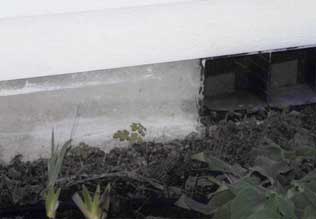
Perimeter treatments are often used in conjunction with wall void treatments for added protection. Typically, a perimeter treatment involves spraying an insecticide such as Termidor Insecticide around the base of the structure where the siding overlaps the foundation (right).

The third, and newest tool, is carpenter ant bait. Baits designed for carpenter ants may be used around the base of the structure or indoors (check label for registered uses).

house foundation

House foundation, siding and foundation vents (black). "Perimeter" treatments should be applied where the siding overlaps the foundation, under the lip of the siding, completely around the house. Photo by JD DeAngelis.


There is no need for periodic maintenance treatments, often recommended by pest control companies, nor is it necessary to locate the carpenter ant nest. Treat only when ant activity is detected during regular inspections.

Avoiding carpenter ant damage

(1) Inspect exterior of structure at least once each year during warm months, morning or evening. Look for large ants moving into or out of the structure in a directed way.

(2) Remove all vegetation in contact with structure to at least 12". This ensures that you will be able to see any ants that are moving into or away from the structure. Ants will also use vegetation to "bridge over" the perimeter treatment (below). Be sure to check the roof for overhanging branches.

(3) If a carpenter ant infestation is found treat exterior wall voids. Wall voids can be treated with a number of different insecticides. Sodium borate dust (Timbor) is a low toxicity choice. You may need to hire a pest control company to do the wall void treatment.

(4) Finally, treat the perimeter space (perimeter treatment) where the house siding overlaps the foundation with Termidor Insecticide. You can do this treatment yourself or have the pest control company do it as the last step.

(5) Treat only when active carpenter ant infestations are found. Periodic maintenance treatments are not necessary.

Related information: [Wood-Damaging Insects]

We now offer pest control advice by e-mail for carpenter ants and other structural pests. Click here for details.


Mission: To provide accurate, up-to-date and unbiased information for solving common insect and mite problems around your home, business and landscape using least-toxic methods.

Jack DeAngelis, Ph.D.

Please see the Disclaimer statements as well (sorry, but these really are necessary).


Copyright 2004-2008 LivingWithBugs, LLC. All Rights Reserved. Page Updated: 4/20/2008